MoreExam
1. Question Content...
EXPLANATION
Answer: X - EXPLANATION Content.
Question1: Your customer wants to demonstrate data privacy compliance by monitoring as many platforms as possible across on-premises and the public cloud with NetApp Cloud Data Sense (formerly Cloud Compliance).In this scenario, which two data sources are supported? (Choose two.)
Question2: You want to protect your data against ransomware attacks In Cloud Volumes ONTAP In this scenario, which two policies should be enabled? (Choose two.)
Question3: You are planning a migration of a single 500 TB workload into NetApp Cloud Volumes ONTAP starting with10 TB and gradually increasing the amount hosted in the cloud. You believe that 80% of the data is cold and will be tiered using data tiering. The most important factor is to minimize the number of licenses as your footprint grows.Which two licensing options would minimize the cost of the licenses in this scenario? (Choose two.)
Question4: Your manager asks you to include steps In your NetApp Hybrid cloud deployment to reduce the risk of a developer accidentally interfering with your mission-critical applications that are in production.In this scenario, which step would you perform?
Question5: You are asked to design a monitoring solution for your Cloud Volumes ONTAP environment for AWS. You decide to enable the Monitoring service in Cloud Manager.In this scenario, which two statements are correct? (Choose two.
Question6: You must configure data replication between a NetApp Cloud Volumes ONTAP system in AWS and a In this scenario, what is a cost-effective way to accomplish this goal?
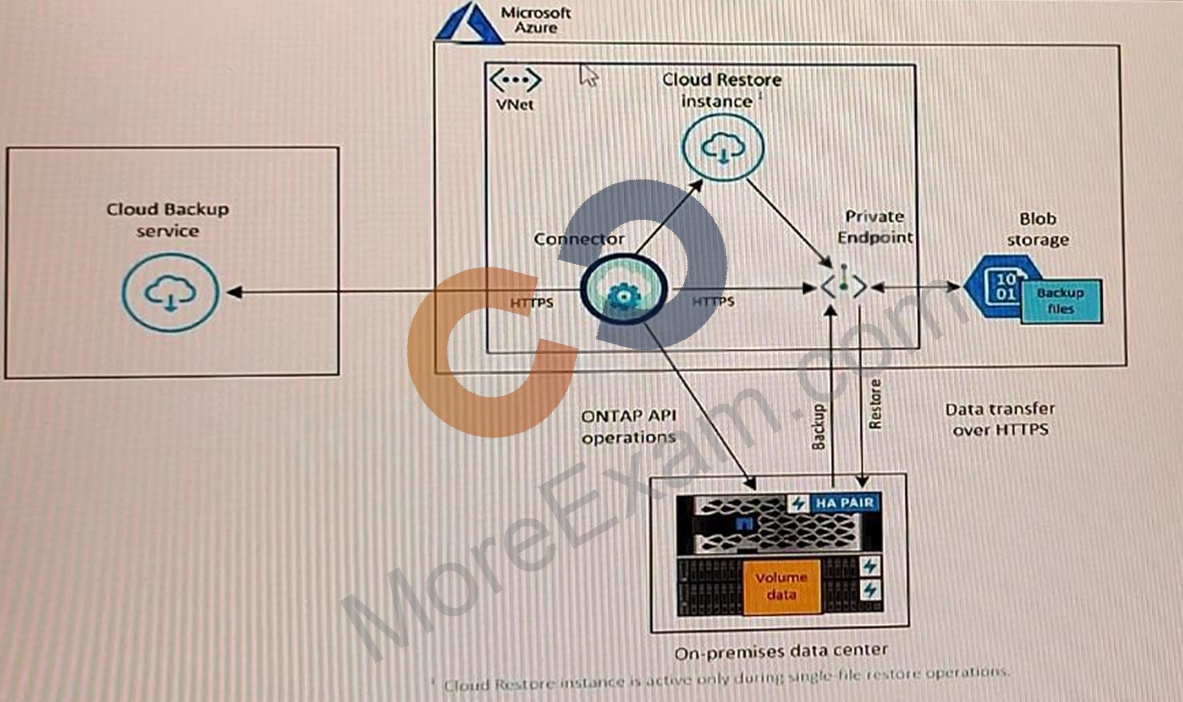
Question7: Exhibit.You are designing a NetApp Cloud Backup solution for your on-premises ONTAP clusters to Azure Blob storage.Referring to the exhibit, which two statements are true? (Choose two.)
Question8: You are using Windows Virtual Desktops and storing user profiles on Azure NetApp Files by using the Premium storage service level. There will be 1000 contractors coming onboard for a short duration to assist with project work, and each one of them requires virtual desktop access.In this scenario, which three actions address the short term performance demand without affecting the latency of existing users? (Choose three.)
Question9: Your team is deploying a containerized application on Kubernetes. The developers are currently collecting metrics for application response times.d Insights to augment theirIn this scenario, what are three ways that you would monitoring? (Choose three.)
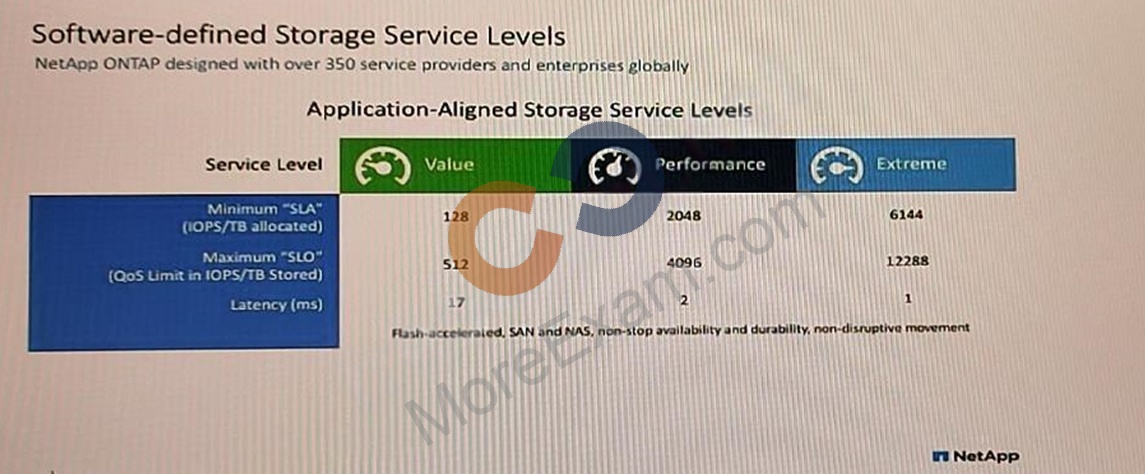
Question10: Exhibit.Referring to the exhibit, a volume in the Value storage service level is storing 10 TB of data.What is the maximum number of IOPS that the volume would receive?
Question11: Exhibit.You are implementing storage-as-a-service using the service levels that are shown in the exhibit. In your implementation plan, which metric is used for the SLA and SLO?
Question12: You are asked to deploy NetApp Cloud Volumes ONTAP In a Google Cloud environment. You set up a NetApp Cloud Central account. You want the storage administrator to be able to log in to the NetApp Cloud Central account and deploy a connector from the SaaS Cloud Manager before deploying NetApp Cloud Volumes ONTAP.In this scenario, what are two requirements to accomplish this task? (Choose two.)
Question13: A customer wants to design a solution that provides unique persistent storage when scaling a StatefuISet application. The customer proposes using a volume claim template in the StatefulSet definition to generate a unique persistent volume and use NetApp Trident to automate the provisioning of the persistent volume.Which Kubernetes object would be used in this scenario?
Question14: You are sizing a new Azure NetApp Flies deployment and are documenting the throughput limit calculations within the design.In this scenario, which two factors are used to accomplish this task? (Choose two.)
Question15: You are designing an automation solution that you will use across both on-premises and cloud-based NetApp ONTAP systems. You want a single automation solution for both locations to reduce the administrative overhead.In this scenario, which two automation tools would you use? (Choose two.)
Question16: Which two domain service providers are supported for authentication of Azure NetApp Files SMB shares?(Choose two.)
Question17: You are designing a solution to detect potential insider threats. Your corporate file shares are hosted on NetApp ONTAP arrays.In this scenario, which two approaches using NetApp cloud services would be appropriate? (Choose two.)
Question18: You need to set up a data resilient configuration for Cloud Volumes ONTAP In AWS. In this scenario, which action will accomplish this task?
Question19: Your company has just merged with another organization. You are responsible for connecting both companies by designing a new multi-region cloud service in Microsoft Azure. Both company's Azure subscriptions and tenants have been merged already. You want to enable cross-region connectivity between the new services and endpoints.In this scenario, which service do you consider?
Question20: You are asked to develop a migration strategy for your customer that is migrating several SMB and NFS workloads from on-premises to Azure NetApp Files.In this scenario, which three technologies should you consider? (Choose three.)
Question21: One volume on your NetApp Cloud Volumes ONTAP Hlgh-Availablllty (HA) cluster has reached a capacity limit.Which two actions would address this issue? (Choose two.)